Buying the building a practice operates from is a different transaction to buying the practice itself. The practice sale is priced on goodwill, patient lists and billing history. The property purchase is priced like any other piece of commercial real estate — but the buyer's profile as a healthcare professional can change what a lender is willing to do with it.
This guide covers financing the premises: the surgery, clinic, consulting suite or specialist facility a doctor, dentist, vet, optometrist, pharmacist or allied health operator buys to work from, whether as an owner-occupier or as an investment leased back to their own practice entity.
If you're buying an existing practice — the business, the patient base, the goodwill — that's a related but separate topic, covered in depth on our medical practice acquisition finance guide.
General information only. Figures cited below are illustrative and deal-dependent, subject to lender assessment — they are not a quote, an offer of finance, or a guarantee of approval.
Why healthcare professionals get a different look from lenders
Lenders price commercial property loans partly on the strength of the borrower's income and partly on the quality of the security. Healthcare professionals often score well on both counts.
Income from medical, dental, veterinary and allied health practice tends to be stable and recurring — Medicare billing, private billing and essential-service demand hold up better through economic cycles than many other commercial tenants. Purpose-fitted premises — plumbed for a dental chair, wired for imaging equipment, laid out for consulting rooms — also tend to have a defined pool of buyers or tenants if a lender ever needs to re-let or sell, which some lenders read as a lower-risk security type than a generic commercial shell.
That combination is why some lenders maintain specific policies for medical and allied-health professionals purchasing commercial premises — separate from their standard commercial lending criteria. It doesn't mean every application gets easier terms. It means the professional's income and the property's use case are both factors a lender weighs, and different lenders weigh them differently.
What "professional" lending policies actually offer
This is the part worth being precise about, because it gets oversimplified in a lot of healthcare finance content.
Some lenders offer higher maximum lending, or a discount on or waiver of Lenders Mortgage Insurance (LMI), to eligible medical and allied-health professionals buying a commercial or practice premises. Where these policies exist, they typically extend to a defined list of professions — doctors, dentists, and sometimes veterinarians, optometrists, pharmacists and specialists are commonly included; other allied health professions are included by some lenders and excluded by others.
None of this is universal, and none of it is fixed. Policies vary by lender, by profession, by the size of the loan, and by whether the purchase is owner-occupied or an investment. They also change — a lender's professional package today may look different in twelve months.
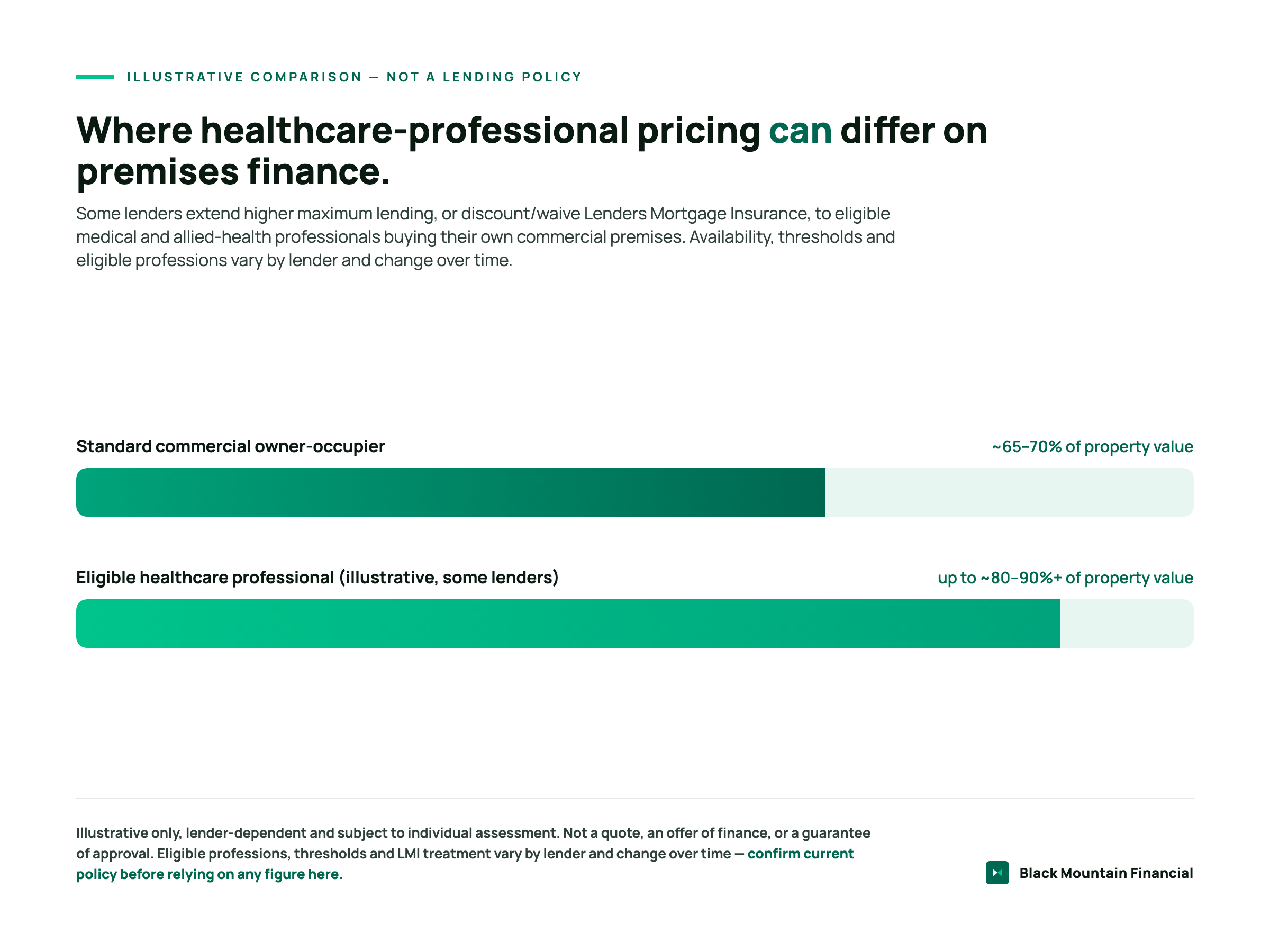
The honest position is this: if you're a healthcare professional, it's worth asking whether a lender's professional policy applies to your situation before you assume a standard commercial LVR is your ceiling. Whether it does, and what it's worth, depends on the lender, your profession, and the deal — not on a number we can quote you in a guide.
Owner-occupied versus investment premises
Most healthcare professionals buying premises fall into one of two positions, and lenders assess them differently.
Owner-occupied — you buy the property and your own practice operates from it, usually paying rent to yourself (directly, or through a related entity). Lenders assess serviceability heavily on the practice's own income, since the practice is effectively the tenant.
Investment — you buy the property and lease it, either to your own practice entity at a market rent or to another operator. Lenders assess this closer to a standard commercial investment loan, weighing the rental income, the lease terms, and the tenant's financial strength — which may or may not be your own practice, depending on the structure.
The choice between the two has tax and structuring consequences beyond the loan itself — depreciation treatment, GST on the purchase, and how rent between related entities is treated. That's accounting and structuring advice, not lending advice, and it sits outside our credit licence. Get it from your accountant before you settle on a structure.
How healthcare professionals structure a premises purchase
There are a few common ownership structures, each with trade-offs a broker and an accountant should walk through together.
- Personal name or trading entity — the most straightforward structure, often used when the practice and the property are closely tied.
- A separate property-holding entity (company or trust) — separates the property from practice trading risk, and can suit succession or partner buy-in planning down the track.
- Self-managed super fund (SMSF) — SMSFs can still borrow to buy *commercial* property under a limited recourse borrowing arrangement, including a practice premises the fund then leases back to the member's own business at market rent. This is a genuinely common structure for healthcare professionals buying their own surgery. It does not apply to residential property. *This is general information, not financial, tax or superannuation advice — whether an SMSF structure suits you is a decision for your licensed financial adviser or accountant, not something we recommend. We arrange the loan once that decision is made.*
What lenders assess on a premises purchase
Beyond the professional-policy question, the fundamentals of a commercial property loan still apply.
- Serviceability — can the practice (or the tenant, if it's an investment) support the loan repayments alongside its other costs, assessed on real cash flow rather than headline revenue.
- Loan-to-value ratio — how much the lender will fund against the property's valuation, which varies by lender, property type and borrower profile as covered above.
- Property quality and use case — purpose-built medical, dental or allied-health premises versus a generic commercial space with a wider or narrower pool of alternative uses.
- Loan term and structure — interest-only periods, principal and interest, and how the term aligns with your practice or investment horizon.
- Existing debt and security — practice equipment finance, working capital facilities, or other commercial debt the lender will weigh alongside the new loan.
Preparing the application
A well-prepared file moves faster and lands better terms than one assembled after the fact. For a premises purchase, that generally means:
- Two to three years of practice financials (P&L, tax returns, BAS)
- A contract of sale or heads of agreement for the property
- Details of the proposed ownership structure (personal, entity, or SMSF)
- If the property will be leased to your own practice: a market-rate lease agreement between the two
- Evidence of deposit or equity contribution, where applicable
- Details of any existing practice debt or security
Getting finance advice before you sign a contract — not after — gives you more room to structure the deal, choose the right ownership vehicle, and identify whether a professional lending policy applies to your purchase.
Where we come in
We're mandated as your adviser on a premises purchase, not paid by a lender to place you with one — so the structure gets built around your practice and your long-term position, not around a panel. Across 100+ lenders, including those with specific policies for medical and allied-health professionals, the work is finding which one actually fits your deal, not pitching the first one that says yes.
If you're weighing whether to buy your premises outright, through a separate holding entity, or through an SMSF, that's a conversation worth having before you sign a contract of sale. We work across the ACT and regional NSW, and if you're also assessing a practice acquisition alongside the property, our medical practice finance team covers that side of the transaction as well.
Frequently Asked Questions
Can I get a lower deposit as a doctor or dentist buying commercial property?
Some lenders offer higher maximum lending, or discount or waive Lenders Mortgage Insurance, for eligible medical and allied-health professionals. Whether it applies depends on the lender, your specific profession, the property type, and whether the purchase is owner-occupied or an investment. It's not a blanket industry rate, and it changes over time — confirm current policy before treating any figure as settled.
Do allied health professionals get the same treatment as doctors and dentists?
Not always. Where professional lending policies exist, they commonly cover doctors, dentists and some specialists as a baseline, with veterinarians, optometrists, pharmacists and other allied health professions included by some lenders and not others. This is genuinely lender-specific — worth checking rather than assuming either way.
Can I use my SMSF to buy my practice premises?
An SMSF can still borrow to buy commercial property, including a premises leased back to your own practice at market rent, under a limited recourse borrowing arrangement. This does not extend to residential property. Whether an SMSF structure is right for you is a decision for your financial adviser or accountant — we arrange the loan once that decision is made, not the strategy itself.
Is buying my premises better than leasing?
It depends on your stage, your capital position, and your plans for the practice. Ownership builds equity and gives you control over the space; leasing preserves capital and flexibility. There's no universal answer — it's worth modelling both against your actual numbers rather than assuming ownership is always the stronger position.
What's the difference between financing the property and financing the practice acquisition?
The property loan is secured against real estate and assessed like commercial property finance, with the professional-policy considerations above. Practice acquisition finance is largely unsecured or secured against the practice itself, and priced on goodwill, patient base and billing history — a different assessment entirely. Many purchases involve both at once, arranged as separate but coordinated facilities.