






Business acquisition finance in Australia gets judged on the wrong number. Most people buying a business focus on the purchase price. The negotiation, the multiple, the valuation — these dominate the conversation. And while price matters, it is rarely what determines whether an acquisition succeeds or fails in the years that follow.
Debt structure is what determines that.
A well-priced acquisition financed poorly will put a business under cash flow strain before it has had the chance to perform. A fairly priced acquisition structured correctly will give the acquirer the capital headroom, repayment flexibility, and balance sheet strength to actually execute on the opportunity they bought.
This article outlines the key structural considerations for business acquisition finance — and where poorly structured debt creates problems that compound long after settlement.
The Most Common Structural Mistake
The most common error in business acquisition finance is treating the business loan as a single facility with a single purpose: fund the acquisition price.
In practice, a business acquisition creates multiple concurrent capital requirements:
- The acquisition price itself — the amount paid to the vendor
- Working capital — the cash needed to operate the business from day one while revenue is being built or stabilised
- Transition costs — legal fees, advisory fees, systems migration, staffing changes, any immediate capex
- A liquidity buffer — reserves to absorb unexpected issues in the first 6–12 months
Acquirers who structure a single acquisition loan for the purchase price and expect existing business cash flow to cover everything else frequently run into problems in month three or four, when the cash that was meant to be there is not.
The facility should be sized and structured to address all of these requirements — not just the headline number.
Matching Debt Tenor to the Asset Being Financed
Debt tenor — the repayment period — should reflect what is being financed and how long that asset takes to generate returns.
A business acquired for its goodwill, client base, and recurring revenue does not amortise like a piece of equipment. It may take 12–24 months before the acquirer has stabilised operations, retained key clients, and begun executing their own growth strategy. If the debt is structured with aggressive short-term repayments during that period, it creates cash flow stress precisely when the business needs capital flexibility most.
Conversely, a business acquired primarily for its physical assets — plant, equipment, property — may support more aggressive amortisation because the underlying assets hold recoverable value.
The principle is that repayment structure should be designed around realistic cash flow, not lender preference or the path of least resistance in the approval process.
Vendor Finance: The Most Underused Tool in Acquisition Structuring
Vendor finance — where the seller takes back a portion of the purchase price on deferred terms — is one of the most consistently underutilised tools in Australian business acquisitions. In many transactions it is never raised. In others it is dismissed too quickly, by either party, without a real understanding of what it can do for the deal.
Used correctly, vendor finance does not just fill a funding gap. It can fundamentally reshape the risk profile of the transaction for everyone involved.
What Vendor Finance Actually Is
In a vendor finance arrangement, the seller agrees to receive a portion of the purchase price over time rather than entirely at settlement. The deferred amount sits as a subordinated obligation — the acquirer owes it to the vendor, typically on agreed repayment terms, sitting behind any senior lender in priority.
The structure can take several forms:
- Deferred payment — a fixed portion of the price is paid at a set future date, often 12–24 months post-settlement
- Instalment arrangement — the deferred amount is repaid in regular instalments over an agreed period
- Earn-out linked — repayment of the vendor component is tied to the business achieving specified performance milestones post-acquisition
- Interest-bearing or interest-free — terms vary; many vendor finance arrangements carry no interest, which effectively reduces the total cost of capital for the acquirer
Why Vendors Agree to It
The most common objection from acquirers is that vendors simply will not accept deferred payment. In practice, this is less true than assumed — particularly where the vendor has a genuine interest in a successful transition.
A vendor who has built a business over 10 or 20 years typically cares about what happens to it after sale. Staff, clients, reputation — these matter. A vendor who takes back finance is, in effect, betting on the ongoing performance of the business and the capability of the acquirer. That alignment of incentives is valuable to both parties.
Vendors also benefit in ways that are not always immediately apparent. Spreading receipt of the sale proceeds can have tax advantages depending on how the transaction is structured. And a well-documented vendor finance arrangement with a creditworthy acquirer is a relatively secure receivable.
The key is raising it early, framing it appropriately, and having the documentation structured by lawyers who understand how it interacts with the senior lender's security position.
What It Does for the Acquirer
The structural benefits are significant:
Reduces senior debt requirement. If the acquisition price is $2M and the vendor takes back $400,000 on deferred terms, the acquirer only needs to source $1.6M from third-party lenders. That reduction in senior debt lowers the ongoing servicing burden from day one — which matters most in the transition period when cash flow is least predictable.
Improves the senior lender's position. A vendor sitting subordinate to the bank is, from the bank's perspective, equity-like. The senior lender's exposure is effectively over a smaller portion of the purchase price, with the vendor absorbing the first layer of downside. Many lenders respond to this favourably in their credit assessment — it can improve approval prospects and sometimes pricing.
Preserves working capital. Every dollar not paid at settlement is a dollar available to fund operations, transition costs, and the liquidity buffer the business needs in its first year under new ownership. This is often the difference between a smooth acquisition and a cash flow crisis at month four.
Creates built-in vendor alignment. When the vendor has skin in the game post-settlement, they have a direct incentive to support the transition — client introductions, staff handovers, knowledge transfer. This is difficult to contractualise effectively through any other mechanism.
Structuring It Correctly
Vendor finance arrangements require careful documentation. The key considerations are:
- Intercreditor agreement — if there is a senior lender, they will almost always require a deed of priority confirming the vendor sits subordinate. This needs to be in place before or at settlement.
- Security for the vendor — vendors understandably want comfort that their deferred amount will be paid. Options include a registered security interest over business assets (noting the senior lender's priority position), a personal guarantee from the acquirer, or a charge over shares in the acquiring entity.
- Default provisions — what happens if the acquirer cannot meet a deferred payment? Clear, documented provisions protect both parties and avoid disputes that can damage the transition.
- Tax and accounting treatment — the structure of vendor finance has implications for both parties' tax positions. This should be reviewed by accountants before terms are agreed.
When to Raise It
Vendor finance is most effectively introduced during the heads of agreement or term sheet stage — before lawyers are deeply involved and before settlement timelines create pressure. Raising it late in the process, or for the first time in the formal contract, tends to create friction.
The framing matters as much as the mechanics. It is not a request for a discount or an indication that the acquirer cannot fund the deal. It is a structural tool that many sophisticated vendors understand and some actively prefer.
If your adviser — whether legal, financial, or otherwise — has not raised vendor finance as an option in your acquisition process, it is worth asking why.
Senior Debt vs. Vendor Finance: Choosing the Right Foundation
Most acquisitions require a combination of funding sources. Understanding how senior debt and vendor finance differ — and how they interact — is fundamental to structuring a deal that works beyond settlement day.
Senior Debt: The Primary Facility
Senior debt is the conventional acquisition loan sourced from a bank or non-bank lender. It sits first in line for repayment, carries the lowest rate relative to its position in the capital stack, and is secured against the assets of the business and, typically, the personal assets of the acquirer.
Senior lenders assess business acquisition finance based on:
- Serviceability — can the business generate sufficient cash flow to service the debt from day one, or at least within a reasonable stabilisation period?
- Security coverage — what tangible assets underpin the loan, and what is the recovery position in a downside scenario?
- Acquirer capability — does the buyer have the experience and financial standing to operate and grow the business?
- Business quality — is the revenue recurring and defensible, or concentrated and fragile?
Senior debt is the non-negotiable component in most acquisitions. The question is how much of the total capital requirement it should cover — and that is where vendor finance becomes a meaningful variable.
How the Two Work Together
Senior debt and vendor finance are not alternatives. They are complementary layers that, structured correctly, produce a more efficient and less risky capital outcome than senior debt alone.
Consider a $3M acquisition:
- Senior debt only: The acquirer funds the full $3M through a lender, carrying the entire servicing obligation from settlement. Working capital must come from business cash flow or additional facilities.
- Senior debt + vendor finance: The vendor takes back $600,000 on a two-year deferred basis. The acquirer sources $2.4M from the senior lender, with lower repayments from day one and $600,000 less in drawn senior debt. The vendor's subordinate position makes the senior lender's $2.4M exposure relatively stronger — which the lender may price favourably.
The difference in cash flow pressure in year one is substantial. The difference in approval probability can also be meaningful, particularly for acquisitions where the business has limited hard asset security and lenders are primarily relying on earnings serviceability.
When Senior Debt Alone Is Appropriate
Vendor finance is not always available or appropriate. Senior debt as the sole funding source makes sense when:
- The vendor requires full payment at settlement — typically in competitive auction processes or where the vendor has pressing liquidity needs
- The business has strong, established, and independently verifiable cash flows that comfortably service the full acquisition debt from day one
- The acquirer has sufficient personal security and capital reserves to absorb the first-year transition without cash flow support
- The acquisition price is below $1M and the servicing burden is manageable without structural complexity
In these cases, a well-structured senior debt facility — sized correctly, with appropriate tenor and covenants — is a clean and efficient solution.
Where the Decision Is Made
The choice between senior-debt-only and a layered structure is rarely obvious at the outset. It emerges from a proper analysis of the business's cash flow under realistic post-acquisition assumptions, the acquirer's balance sheet and risk appetite, and the vendor's flexibility.
That analysis should happen before an offer is made — not after heads of agreement are signed and the clock is running.
The Role of Covenants and What They Mean in Practice
Commercial acquisition loans — particularly from banks — typically include financial covenants: ongoing conditions the borrower must satisfy throughout the life of the facility.
Common covenants include:
- Debt Service Coverage Ratio (DSCR) — the business must generate sufficient earnings relative to its debt obligations. A DSCR covenant of 1.25x means the business must earn $1.25 for every $1.00 of annual debt repayment.
- Interest Cover Ratio — similar in concept, focused on the relationship between earnings and interest expense
- Maximum leverage ratio — limits total debt as a multiple of EBITDA
- Cash reserve requirements — some lenders require minimum cash balances to be maintained
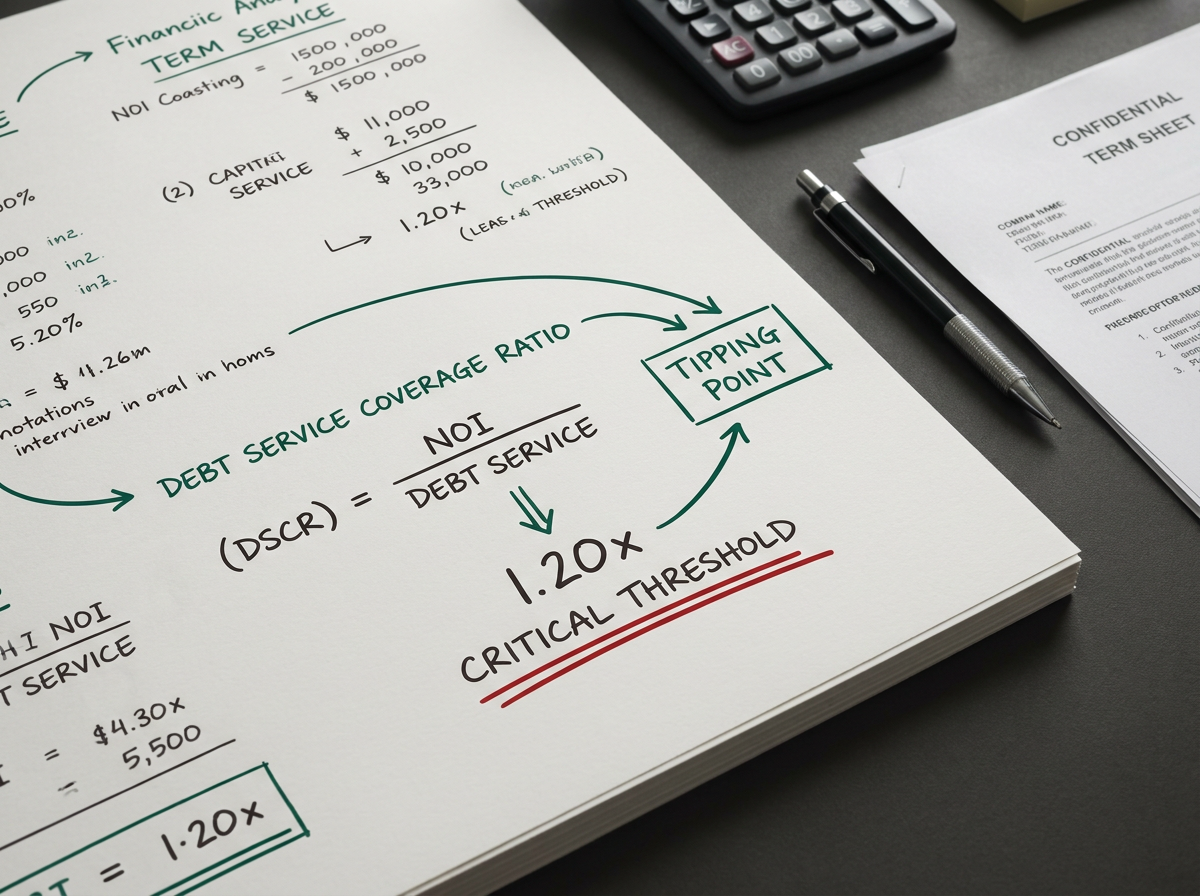
Covenants are not inherently problematic. What creates risk is when acquirers agree to covenants that the business can only satisfy under optimistic operating assumptions — and then face a covenant breach in year two when trading normalises.
Before signing an acquisition facility, it is worth stress-testing the covenants against a conservative revenue scenario. If a 15% revenue reduction in year one would cause a breach, the structure needs to be revisited.
Security: What You Are Putting on the Line
Third-party lenders providing acquisition finance will almost always require security. The question is what form that security takes and how it is structured.
For business acquisitions, security typically includes some combination of:
- A charge over the business assets (registered GSA)
- Personal guarantees from the acquirer (and often their spouse)
- Mortgage over residential or commercial property
One of the most important conversations in acquisition structuring is what security the acquirer is comfortable providing, and how that maps to the lender's requirements. Offering more security than necessary to get a deal approved is a common mistake — particularly when the property being offered as security has other purposes in the acquirer's balance sheet.
A properly structured acquisition should use the minimum security necessary to achieve approval at appropriate terms, not the maximum available to the borrower.
Why Acquisition Finance Is Not a Commodity
Business acquisition finance in Australia is one of the most complex areas of commercial lending. Unlike a straightforward commercial property mortgage — where the security is a registered asset and serviceability is relatively transparent — acquisition finance requires lenders to make judgements about:
- The reliability of historical business earnings
- The likelihood of those earnings being maintained post-acquisition
- The acquirer's capability to operate and grow the business
- The risk of key-person dependency in the vendor's client relationships
- The quality of the transition plan
Different lenders have materially different risk appetites for these variables. The same acquisition that one lender declines in principle, another may fund at competitive terms — because their credit policy is better aligned with the deal type, or because the submission was structured to address their specific requirements.
This is why the lender selection process for an acquisition is as important as the acquisition itself.
Getting the Structure Right from the Start
At Black Mountain Financial, we have structured and managed business acquisition finance for transactions ranging from small professional services businesses to multi-site commercial operations. The pattern we see consistently is that the acquisitions that go smoothly are not necessarily the ones with the best purchase prices.
They are the ones where the capital structure was designed around the actual business and the acquirer's objectives — not assembled in a hurry to meet a settlement date.
If you're structuring business acquisition finance in Australia and want an independent view on what a properly funded deal looks like for your situation, speak to us before you sign anything.
Black Mountain Financial is a debt advisory practice based in Canberra, providing commercial and residential finance advisory services to business owners, property developers, and professional services firms across the ACT and regional NSW.
Frequently Asked Questions
What is vendor finance in a business acquisition?
Vendor finance is where the seller agrees to receive a portion of the purchase price over time rather than entirely at settlement. The deferred amount sits as a subordinated obligation behind any senior lender, and can take the form of a deferred payment, an instalment arrangement, or an earn-out linked to business performance.
What should acquisition finance cover beyond the purchase price?
A business acquisition creates multiple concurrent capital requirements: the acquisition price itself, working capital to operate from day one, transition costs such as legal and advisory fees and systems migration, and a liquidity buffer to absorb unexpected issues in the first 6–12 months. The facility should be structured for all of these, not just the headline number.
Why would a vendor agree to deferred payment?
Vendors who built a business over many years typically care about a successful transition — staff, clients and reputation. Taking back finance aligns their interests with the acquirer, can carry tax timing advantages depending on structure, and a well-documented arrangement with a creditworthy acquirer is a relatively secure receivable.
What security do lenders require for business acquisition finance?
Typically some combination of a registered General Security Agreement over the business assets, personal guarantees from the acquirer, and sometimes a mortgage over property. A properly structured acquisition uses the minimum security necessary to achieve approval at appropriate terms — not the maximum available.
What are financial covenants on an acquisition loan?
Covenants are ongoing conditions the borrower must satisfy — commonly a Debt Service Coverage Ratio (e.g. 1.25x means earning $1.25 for every $1.00 of annual debt repayment), interest cover, maximum leverage, and cash reserve requirements. Stress-test them against a conservative revenue scenario before signing: if a 15% revenue reduction would cause a breach, the structure needs revisiting.